Is “Autopilot” Killing Your Sales? Take the 7-Day Challenge Today by Dan Coleman
Many sales teams believe they’re being efficient.
In reality, they’re on AUTOPILOT – repeating the same playbook over and over again.
You’ve likely seen it in your pipeline review meetings – your team is stuck:
- Running the same discovery questions
- Recycling proposals and using standard presentations that don’t catalyze enough action
- Generating account plans that are simply carbon copies of last year’s plans
- Using negotiation tactics that follow old patterns of concessions instead of bold value claims
Even your top performers fall back on habitual tactics and mental scripts.
It feels efficient, but it’s not fostering creativity – it’s actually quietly killing it. Deals aren’t as inventive or as profitable as they could be, opportunities stall, and instead of expanding the pipeline, the team settles for outcomes far below their potential.
A Hidden Force: Fixed Thinking and Perceiving Habits
Some leaders assume one root problem is a lack of discipline. In reality, a deeper issue is the rut of fixed thinking and perceiving patterns and habits. Over time, individuals and teams develop patterns and habits based on familiarity, speed, and past success. Unless we continually challenge them, these patterns and habits become automatic “resistors” that push back against new thinking.
You can spot these resistors in everyday behavior:
- Rote Discovery: Conversations default to the same familiar questions rather than exploring new angles that uncover hidden value.
- Safe Bets: Presentations rely on old slide decks and standard messaging that feel comfortable but rarely spark new thinking with the customer.
- Copy/Paste Strategies: Account plans are built by recycling last year’s ideas instead of reimagining how the relationship could grow.
- The Discount Fallback: Negotiations drift toward price concessions rather than bold value claims that expand the opportunity.
These habits aren’t laziness – they are the brain’s way of minimizing effort and risk while moving quickly toward a close.
But the downside is significant: when these patterns take over, it becomes much harder to see new possibilities, structure creative deals, or approach an opportunity with fresh thinking that truly wows the customer.
The 7-Day Reset Experiment
Breaking these patterns doesn’t require a massive training overhaul. Instead, use “Live-With” experiments – small, deliberate exercises designed to interrupt autopilot thinking in real-time.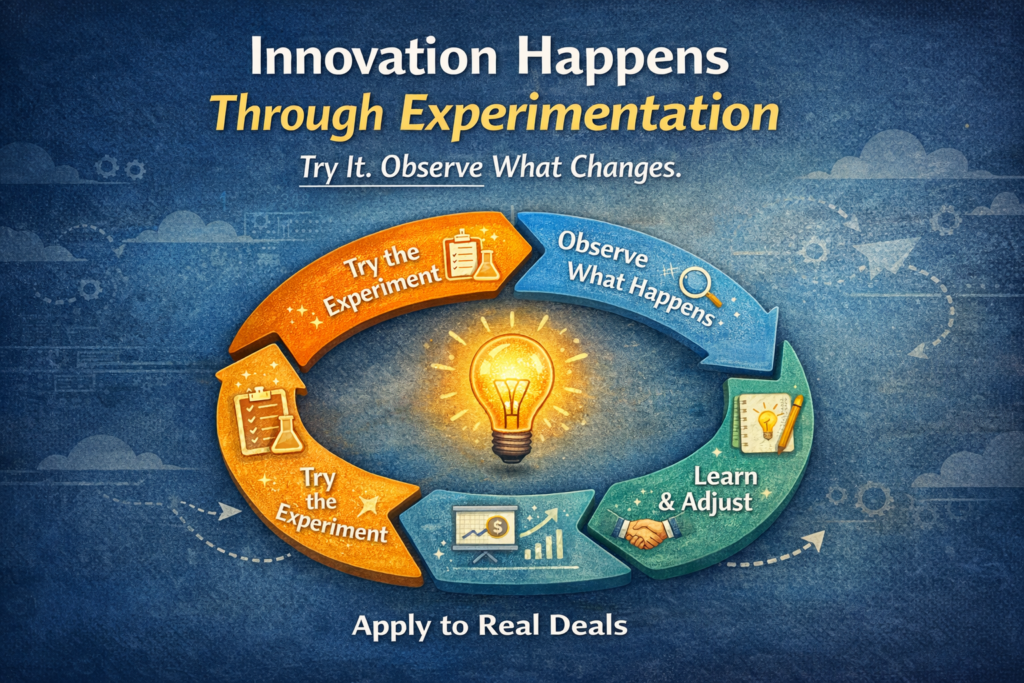
Why These Exercises Work
Most teams think innovation fails because people don’t try hard enough.
In reality, it often stalls because automatic thinking and perceiving patterns and habits block new thinking. These short “Live-With” experiments interrupt those patterns and create space for new thinking. Spend 1–2 days on each experiment over the course of a week and observe what changes.
Here are 3 Simple but Powerful “Live-With” Experiments to Try This Week
1. Defer Judgment and Separate Idea Generation From Evaluation

- The Principle: Keep novel ideas open for as long as possible and resist the knee-jerk temptation to immediately judge them while you diverge and brainstorm. Generating ideas and critiquing them uses different parts of the brain, limiting creativity. It’s analogous to writing and editing – you can’t do both well simultaneously.
- The Experiment: Apply the following four principles of diverging: 1) Defer judgment by putting some time between the two thinking processes. 2) Make quantity your friend – you increase your odds of generating unique ideas if you are working from many. 3) Seek wild and unusual ideas – the wilder the better. 4) Take time to build on, combine, hitchhike, and synthesize ideas.
- The Impact: Allow novelty to surface – once the obvious ideas are out of the way, the ideas that actually have a chance to break through start to appear if you allow them to. From there, you converge and work to make the novelty feasible and valuable. This method of holding ideas open longer than usual is very powerful and stretches thinking, resulting in more original and useful ideas.
2. Use Analogical Thinking

- The Principle: Borrow smart ideas from unexpected places. Innovation rarely comes from inventing something entirely new; it usually comes from making new combinations. Take an idea or element of it that works somewhere else (e.g., different industry, application) and force-connect the idea or elements of it to work in your own context.
- The Experiment: Ask your team the following questions:
- “How would a lawyer handle this client’s problem?” Think about how a lawyer anticipates objections, constructs evidence step by step, or presents a compelling argument that connects to both logic and emotion.
- “How would you transform your standard proposal into a structured, dynamic, fact-based, and emotional step-by-step story “case” that clearly shows your solution’s value and catalyzes action?”
- “How can you anticipate and preemptively address objections before the prospect raises them?”
- The Impact: Suddenly, your team isn’t just another “vendor.” You’re approaching the client consultatively, like someone who truly understands their world and their challenges, and that’s how trust and respect are built.
3. Set an Idea Quota

- The Principle: Make quantity your friend – quantity breeds quality. The first few ideas will almost always be the obvious ones. The breakthroughs usually come later.
- The Experiment: Pick your top prospect and come up with at least 15 different ways or approaches to reach them this week, anything from a short insight email to a quick LinkedIn video, or even a small physical mailer that grabs attention.
- The Impact: This forces your team past “checking the box” and into the kind of persistent, creative follow-through that will help to gain access to key influencers and decision makers. By forcing yourself out of your comfort zone with quantity, the breakthrough ideas you hadn’t thought of at the start will begin to surface, and those are usually the ideas that matter most. As a result, your team begins uncovering ideas that wouldn’t surface through conventional thinking.
Take a Short Break, Incubate and Reflect
Experimentation works best with a brief pause. After a week, spend 15–20 minutes reviewing:
- What experiments did we try?
- What worked? Why? Why not?
- What did we learn?
- What should we adjust next week?
This quick reflection strengthens learning and reinforces new thinking.
Take the First Step – Try the 7-Day Experiment
Selling innovation rarely happens by accident. It happens when individuals and teams deliberately challenge assumptions and experiment with new approaches. The result isn’t just more novel ideas… It’s a more flexible, innovative sales mindset.
Commit to a 7-day experiment this week.
- Start small.
- Try the three Live-With exercises with your team.
- Observe what happens as new questions emerge, fresh angles appear, and opportunities open in unexpected ways.
Ready to keep the momentum going?
Download Break It Thinking™, a quick reference guide designed to help your team build a repeatable habit of innovative thinking.
If you’d like to explore how this Selling Innovation method could work inside your organization, schedule a conversation with Dan.
